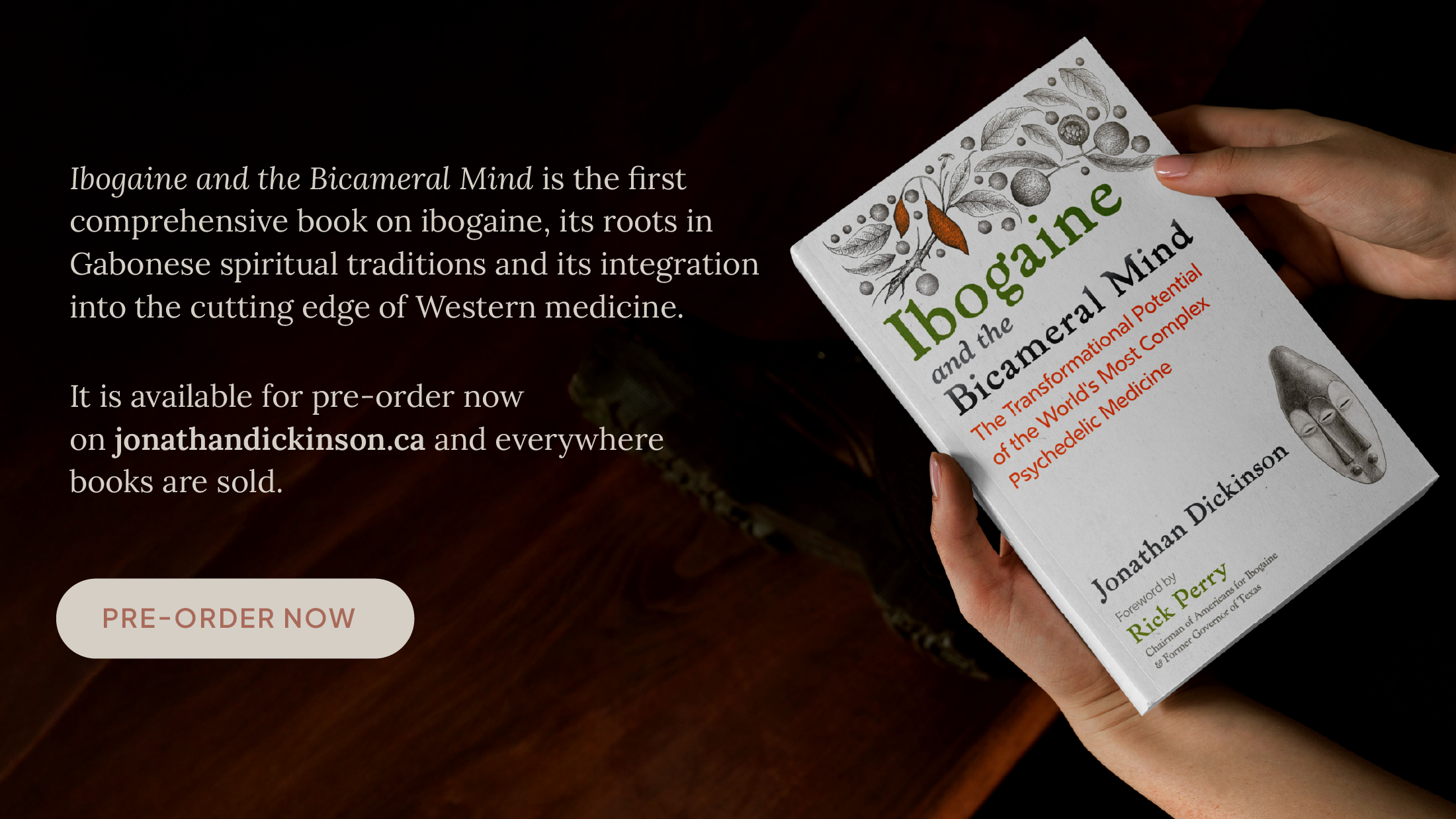
Press Release


In Ibogaine and the Bicameral Mind, I described a very distinctive feature of the ibogaine experience. Blindfolded and lying in the dark, about 75% of participants who I interviewed described some form of dialogue with an other. Not the caretakers in the room, but something else that appeared either as a dreamlike image embodied in front of them, or as sound, thought, or image organized in some other way in response to questions that they raised.
I drew a parallel between this phenomenon and Julian Jaynes’ theory of the bicameral mind, a feature that he posited, defined the cognition of our ancient ancestors. Although “aware” of their actions and the savoire faire (know-how) that drove day-to-day decision making, he suggested that our ancestors were not otherwise “conscious” in the sense of modeling and testing novel problems the way we take for granted today. Instead, in moments of novel decision-stress, where tradition failed to provide a solution, a creative protoconscious part of the mind would speak through a voice that seemed to come from an other within.
Jaynes supposed that modern consciousness emerged from the breakdown of this bicameral structure, a transition that was documented through poetry and language as we transformed from the mythology of ancestors, gods, and spirits, to the discourses of philosophy and science. We might imagine the ancient mind full of the chaos and drama of numerous gods and spirits competing for viability, and then gradually compelled to prioritize a single monotheistic truth. Ignoring this legion of voices in pursuit of a higher order, we gradually emerged into enlightenment as the mind developed perspective and a capacity to model reality and engineer scientific solutions. The voice of the gods, and then of God, died, as Nietzsche declared… if not in a theological sense, at least experientially.
Like many thinkers of the 20th century, Jaynes saw this progression as linear, perhaps inevitable. Yet in the same instant that we can protocolize a timeline to make civilization interplanetary, we face a rampant mental health crisis. The solution, unfortunately, is not something that we can map out with the same logical tools. Modernity has abandoned subjectivity but wonders why it has failed in the effort to medicalize the mind and behavior. Now troubling numbers of people wrestle with severe addiction and suicidal ideation, while our best efforts to intervene only exacerbate the problem.
In a dramatic attempt to recover, vast swaths of the population have defied their governments to explore the use of psychedelics. Serious research institutions search for ways to integrate ancient psychoactive plant medicines into the healthcare system. And unexpectedly, ibogaine, one of the strangest and most complex of these medicines has captured the political moment, becoming a national research priority for the United States government.
If ibogaine helps to surface an older bicameral structure in the mind, what can we interpret from the fact that ibogaine also promises to service some of our most intractable social problems? If there are other modes of cognition, what does this finding signal about the limits of consciousness thought and our capacity to address problems of the mind?
One of the signposts that I circled back to throughout the book was a comment made to me by a Missoko Bwiti grandmaster named Henri Paul Moubeyi Bouale, also known by his initiated name Missengue. As we sat preparing to enter the temple before an all-night vigil, he explained:
“We are animists. We believe that all matter is made of energy, and it is the same energy that was present at the big bang. If we learn the language of things in the world, then we can learn to communicate directly with God.”
His offhand description struck me as a living theology, noticeably absent of anthropomorphism. Rather than a realm you visit populated by beings you meet, a language is something you inhabit, are changed by, and never finish learning.
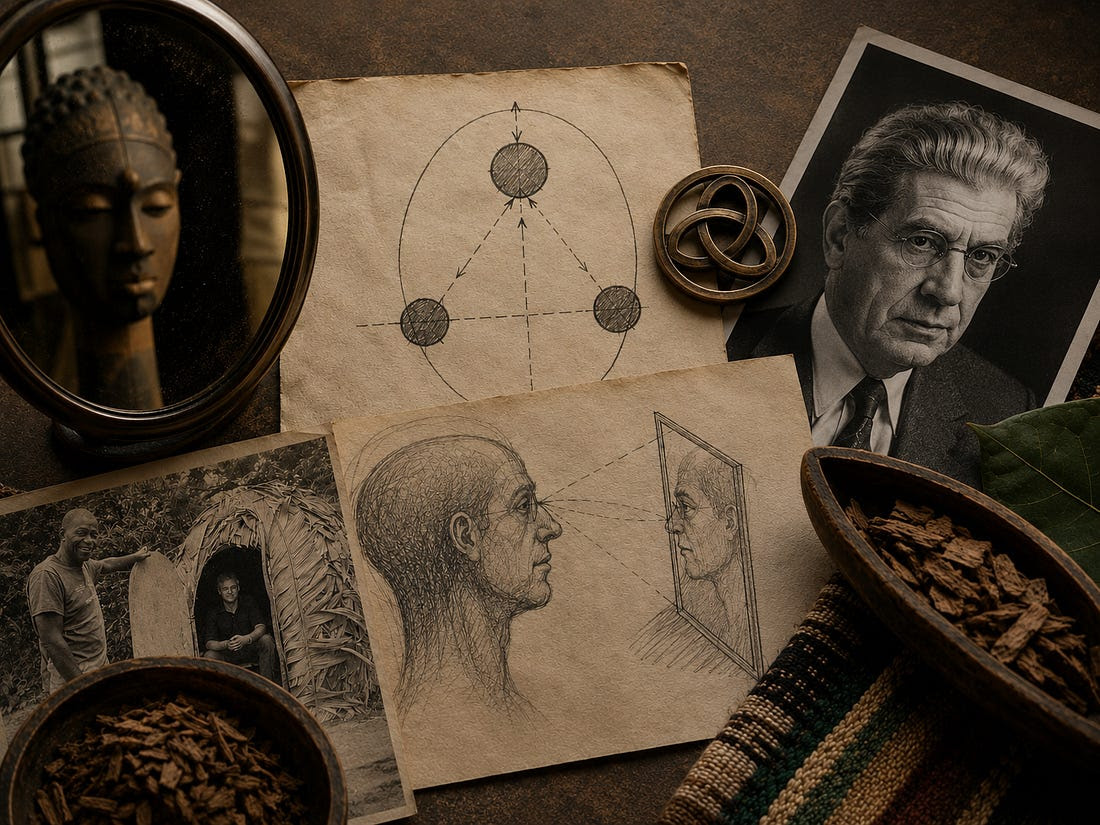
When we entered the temple, Missengue gave me the gift of a small trefoil knot, a symbol that I later found in the work of French psychoanalyst Jaques Lacan. The synchronistic link between Lacan’s work and Bwiti overlapped in numerous ways, including around the symbolic function of mirrors. For Lacan, the recognition of our self-image during the “mirror phase” in infancy created an important rupture that defined the maturing psyche, while for Bwitists our reflection amplified a symbolic gap that catalyzed part of the initiation process.
Lacan’s theories are famously (even punitively) difficult to unpack, and I only explored a few key ideas in the book. One that I neglected was Lacan’s distinction between the small other and the big Other.
The small other is the mirror. It is your own image, your double, your rival, or anyone you meet and relate with. It is the register of identification and reflection. Many of the figures you encounter in visions are essentially a part of yourself in costume, projections you could in principle recognise and reabsorb.
The big Other is not a person at all. It is the whole symbolic order, including language, law, lineage, the entire matrix of meaning that was running long before you arrived and will keep running after you leave. You are not like it. You are inside it. You cannot hold it up to your face like a mirror, because it is not a reflection of you. It is the structure that made “you” possible in the first place.
In one of his seminars, Lacan offered what he called the true formula of atheism, which was not “God is dead,” and he was pointed about why. To found everything on a murdered father, as Freud did, keeps the father enthroned. A dead god is still a god. You have simply moved him into the past tense and built an altar over the grave. Instead, Lacan said, “God is unconscious.”
Jung came to a tangential conclusion, writing that “God is the unconscious”, imagining the unconscious as a numinous reservoir connected to a deep collective memory. Lacan’s sentence does not relegate God to this reservoir. “God is unconscious.” Amongst its interpretations, we can say that even the person who consciously and sincerely denies God still acts as though some ordering principle guarantees the meaning of their life. God did not go anywhere. It became the silent grammar you obey without noticing. Therefore, God, for Lacan, is the big Other, the symbolic order, language itself.
Through disciplined examination of direct experience, Lacan arrived at the same conclusions as a Bwiti Grandmaster in a forest temple in Gabon more than half a century later. Together, they offered some formal structure to what I witnessed in my research of ibogaine phenomenology.
The observation of the Other and ibogaine’s potential to make this language audible is not just beautiful, mysterious, and numinous. It matters, because Lacan points out that the Other is the field in which the subject is constituted. We do not pre-exist the encounter and then get measured by it. We come into being within the dialogue, as a speaking being, in relationship to the Other. Similarly, Bwiti doesn’t describe the initiatic encounter as a rebirth, but as a first instance of birth. It is our initial emergence into a spiritual and symbolic order.
That the silent grammar we spend our lives mistaking for our own thoughts turns around to address us directly is not a side effect, and any science that brackets the Other not only misses something poetic, but neglects to understand our crisis and the remedy. Modern medicine objectifies, industrializes, optimizes, but fails to place us as subjects within the existential discourse.
The conquest to understand ibogaine’s outcomes, to find the predictive biomarkers for who it will cure, are all blunt failures to engage with the raw data of ibogaine’s subjectivities.
Only one of these viewpoints is initiated to a direct observable experience, the other opposes.
I don’t say that healing or actualization for any individual is dependent on hearing a voice, or even on an audible voice making sense of our experience. Instead, the emergence of bicameral phenomena in the ibogaine experience is a signal that helps to illuminate a new view of the mental health crisis.
This is not an arbitrary observation. The act of taking ibogaine today -- while it is a Schedule I narcotic, prohibited by the US government -- is an act of sovereignty and a reclamation of a personal means to discover the meaning in health. Research and healthcare institutions will have to consider, to what extent are they structurally capable of preserving the agency that underlies a patient’s ability to name and define their own experience? One good indicator may be the extent to which they remain curious about, and honor the strange encounter with the other.